Arthur Momand (1886-1987)


Medium: Oil on canvas
Image Size: 24” x 20”
Frame Size: 32” x 28”
Signature: Signed lower right
Price: $2800
Biography/Statement
American cartoonist best known for his comic strip Keeping Up with the Joneses. Momand spent his childhood in New York City, where he attended the Trinity School. In 1905 or 1907, Harry Grant Dart hired Momand as a staff artist for the New York World, where he produced a variety of comic strips including Mr. I. N. Dutch. He also worked at the Evening Telegram, where he created the comic strip Pazaza. After this, he spent a year studying art at the Académie Julian. Momand’s comic strip “Pazaza”, January 3 1910. In 1913, he created Keeping Up with the Joneses, based on his Nassau County experiences. The strip appeared in early issues of both Funnies on Parade and Famous Funnies; and was syndicated until 1938. After retiring from cartooning, Momand became a portrait painter. In 1910, he was married to May Harding, and lived in Nassau County, New York (either Cedarhurst or Hempstead). Unable to afford the Nassau County lifestyle, they eventually moved back to Manhattan. Momand and Harding subsequently divorced, and in 1928 he married Mayo Deason in Lucerne, Switzerland.
Artist Profile Page: Momand, Arthur / Categories: Portrait
Other Available Works by this Artist:
Similar Works

Carlino, Charles

English Portrait

HopperEdward

Greuze,Jean-Baptiste

Larsen-Sarslov, Frederick

Morgan, William Penn

Sully, Thomas

TannerHenry Ossawa

Theise, Mike

Titian

Titian
Henry Ossawa Tanner (1857-1937) American
Pomp The Lion in the Philly Zoo. Attributed to Henry Ossawa Tanner


Medium: Oil on canvas
Image Size: 24” x 20”
Frame Size: 35” x 31”
Price: $24000
*Attributed to / Not signed (or copy of orig. work)
Biography/Statement
America’s first internationally renowned African-American artist, Henry Ossawa Tanner was born in Pittsburgh to a well-educated and devoutly religious family. When Henry was age 13, his father, the Reverend Benjamin Tucker Tanner, moved the family to Philadelphia.
With the support of his parents and inspiration from the art of the 1876 Philadelphia Exposition, he enrolled in the Pennsylvania Academy to study with Thomas Eakins who became a close friend.
Tanner briefly painted animals and was determined to become the “American Landseer” in response to the demand for animal portraits. Between 1886 and 1887 Tanner was an illustrator for Harper Brothers, a publishing firm willing to advance black artists and writers.
He then moved to Atlanta, Georgia, where he briefly and unsuccessfully ran a photography studio, but by 1891 he turned back to painting and sailed for France.
In Paris he studied at the Julian Academy with Benjamin Constant and J.P. Laurens. He received many honors and was considered a ‘strong man’ at Julian’s before his first Salon picture. He traveled to celebrated locations as Pont-Aven, but remained relatively unswayed by contemporary art movements. Tanner discovered the Salons and their power to advance a painter’s career, both abroad and in America.
The acceptance of his painting, The Banjo Lesson by the 1894 Salon marked both a “turning point in his career and a shift in emphasis in his choice of subject, for it was his first major exploration of the pathos of the black in society.”
He returned briefly to Philadelphia but decided Paris was his natural home. At first, he was highly successful with genre painting but switched to religious subjects in the mid-1890’s and traveled extensively in the Near East to absorb Biblical references.
In 1899, Tanner married Jessie Macauley Olssen, a white Californian, and decided to make France his home for the remainder of his life. He feared that Americans would not be accepting of an interracial marriage.
In 1908, he wrote of France, “There is a breadth, a generosity, an obsolete cosmopolitanism about her recognition of the fine arts, which bars no nationality, no race, no school, or variation of artistic method.”
Sources include:
Antiques Magazine
Peter Falk, Who Was Who in American Art
Artist Profile Page: Tanner, Henry Ossawa / Categories: Figurative, Portrait
Other Available Works by this Artist:
Similar Works

Brackman, Robert
Carlino, Charles
English Portrait

Guy, Seymour Joseph

Harper, William St. John
HopperEdward
Greuze,Jean-Baptiste
Larsen-Sarslov, Frederick

Low, Will Hicok

Momand, Arthur
Morgan, William Penn

Philipp, Robert

Sohn, Karl Rudolf

Spurr, Barbara
Sully, Thomas
Theise, Mike
Titian
Titian
Edward Hopper (1882-1967) American
Self portrait attributed to Edward Hopper


Medium: Oil on canvas
Image Size: 24” x 18”
Frame Size: 32” x 26”
Price: $28000
*Attributed to / Not signed (or copy of orig. work)
Biography/Statement
Born in 1882 in Nyack, a small town on the Hudson River about forty miles north of New York City, Edward Hopper was the son of a local businessman. After spending a brief period at a school for illustrators, he attended the New York School of Art from 1900 to 1906. His teachers there were William Merritt Chase, Kenneth Hayes Miller, and Robert Henri. Henri, above all, became important to Hopper, not so much in artistic as in personal terms, for Henri was a man who set high standards for himself and his students. It was also he who pointed out that everyday American life contained an inexhaustible reservoir of new and untried subject matter.
Robert Henri has gone down in art history as a co-founder of The Eight, a group of artists who in spring 1908, prevented from exhibiting in the prestigious National Academy of Design, mounted their own show at the Macbeth Gallery, New York. Henri set European masters on a par with the American artists he admired, even giving them priority, and that not only in chronological terms. In the late 1880s and the middle of the 1890s, Henri had studied in Paris for extended periods, responding to the call of France like many American artists of the day, before returning home with a renewed consciousness of their American roots. To his students, Henri extolled the old and modern masters who meant so much to him: Rembrandt, Diego Velazquez, Vermeer, Manet, Degas, Daumier – an odd mixture, but indicative of the eye of a born realist who was interested above all in the representation of the human figure.
Being a student of Robert Henri, Hopper was almost preordained to go to Paris. His initial stay lasted from October 1906 to August 1907. Unlike his teacher, Hopper did not enroll in a school or academy, but conducted his studies in museums and on the streets. He returned to Paris twice, in 1909 and 1910, for brief stays.
The key accomplishment of the early period was an assimilation of Impressionism. Hopper’s palette grew lighter, his brushwork freer, and his observation more precise. His approach to motifs began to show a growing independence from any model or ideal, both in the American subjects and the Paris ones. Under the Impressionist spell, Hopper discovered the unique light of Paris: “The light was different from anything I had known,” he later recalled. “The shadows were luminous, more reflected light. Even under the bridges there was a certain luminosity.”
From Paris Hopper undertook trips to Amsterdam, London, Brussels, Berlin, Madrid, and Toledo. In the Netherlands, apart from Rembrandt, he discovered Vermeer as a painter of spiritual illumination and an incomparable master of the intimate interior. Among French painters, Hopper was impressed by Manet and Edega Degas, Camille Pissarro and Sisley, but the deepest involvement came with the work of Monet, Cezanne, and Van Gogh. Fauvism and the beginnings of Cubism, on the other hand, seem to have escaped Hopper’s notice. His preoccupation with the great masters, among whom the Impressionists were already beginning to figure, apparently led Hopper to overlook the contemporary avant-garde. “Whom did I meet? Nobody,” he later admitted. “I’d heard of Gertrude Stein, but I don’t remember having heard of Pablo Picasso at all.”
In the 1910s, Hopper struggled for recognition. He exhibited his work in a variety of group shows in New York, including the Exhibition of Independent Artists (1910) and the famous Armory Show of 1913, in which he was represented by a painting titled “Sailing”. Although he worked primarily in oil painting, he also mastered the medium of etching, which brought him more immediate success in sales. He began living in the Greenwich Village neighborhood, where he would continue to maintain a studio throughout his career, and he adopted a lifelong pattern of spending the summers in New England. In 1920, at the age of thirty-seven, he received his first one-person exhibition. The Whitney Studio Club, recently founded by the heiress and arts patron Gertrude Vanderbilt Whitney, showed sixteen of his paintings. Although nothing was sold from the exhibition, it was a symbolic milestone in Hopper’s career.
Just a few years later, Hopper found himself in a far more prosperous and prominent position as an artist. His second one-person exhibition, at the Frank K. M. Rehn Gallery in New York, was such a commercial success that every painting was sold; the Rehn Gallery would represent him for the rest of his career. In 1930, his painting House by the Railroad was the first work to be acquired for the collections of the newly founded Museum of Modern Art. This image embodied the characteristics of Hopper’s style: clearly outlined forms in strongly defined lighting, a cropped composition with an almost “cinematic” viewpoint, and a mood of eerie stillness. Meanwhile, Hopper’s personal life had also advanced: in 1923, he married the artist Josephine Verstille Nivison, who had been a fellow student in Robert Henri’s class. Jo, as Hopper called her, would become an indispensable element of his art. She posed for nearly all of his female figures and assisted him with arranging the props and settings of his studio sessions; she also encouraged him to work more extensively in the medium of watercolor painting, and kept meticulous records of his completed works, exhibitions, and sales.
In 1933, Hopper received further critical recognition as the subject of a retrospective exhibition held at the Museum of Modern Art. He was by then celebrated for his highly identifiable mature style, in which urban settings, New England landscapes, and interiors are all pervaded by a sense of silence and estrangement. His chosen locations are often vacant of human activity, and they frequently imply the transitory nature of contemporary life. At deserted gas stations, railroad tracks, and bridges, the idea of travel is fraught with loneliness and mystery. Other scenes are inhabited only by a single pensive figure or by a pair of figures who seem not to communicate with one another. These people are rarely represented in their own homes; instead, they pass time in the temporary shelter of movie theaters, hotel rooms, or restaurants. In Hopper’s most iconic painting, Nighthawks, four customers and a waiter inhabit the brightly lit interior of a city diner at night. They appear lost in their own weariness and private concerns, their disconnection perhaps echoing the wartime anxiety felt by the nation as a whole.
The Hoppers spent nearly every summer from 1930 through the 1950s in Cape Cod, Massachusetts, particularly in the town of Truro, where they built their own house. Hopper used several nearby locations as frequent, repeated subjects in his art. He also began to travel farther for new imagery, to locations ranging from Vermont to Charleston, an automobile trip through the Southwest to California, and four visits to Mexico. Wherever he traveled, however, Hopper sought and explored his chosen themes: the tensions between individuals (particularly men and women), the conflict between tradition and progress in both rural and urban settings, and the moods evoked by various times of day.
Hopper’s work was showcased in several further retrospective exhibitions throughout his later career, particularly at the Whitney Museum of American Art in New York; in 1952, he was chosen to represent the United States at the Venice Biennale. Despite commercial success and the awards he received in the 1940s and 1950s, Hopper found himself losing critical favor as the school of Abstract Expressionism came to dominate the art world. Even during an era of national prosperity and cultural optimism, moreover, his art continued to suggest that the individual could still suffer a powerful sense of isolation in postwar America. He never lacked popular appeal, however, and by the time of his death in 1967, Hopper had been reclaimed as a major influence by a new generation of American realist artists.
Artist Profile Page: Hopper, Edward / Categories: Portrait
Other Available Works by this Artist:
Similar Works
Carlino, Charles
English Portrait
Greuze,Jean-Baptiste
Larsen-Sarslov, Frederick
Momand, Arthur
Morgan, William Penn
Sully, Thomas
TannerHenry Ossawa
Theise, Mike
Titian
Titian
Boston School (1890-1910) American
Boston School Portrait Of Edward Breck (American, 1861-1929)


Medium: Oil on canvas
Image Size: 34” x 30”
Frame Size: 44” x 40”
Price: SOLD
Biography/Statement
Artist Profile Page: Boston School / Categories: Portrait
Other Available Works by this Artist:
Similar Works
Carlino, Charles
English Portrait
HopperEdward
Greuze,Jean-Baptiste
Larsen-Sarslov, Frederick
Momand, Arthur
Morgan, William Penn
Sully, Thomas
TannerHenry Ossawa
Theise, Mike
Titian
Titian
Thomas Sully (1783-1872)
The Andrews Misses
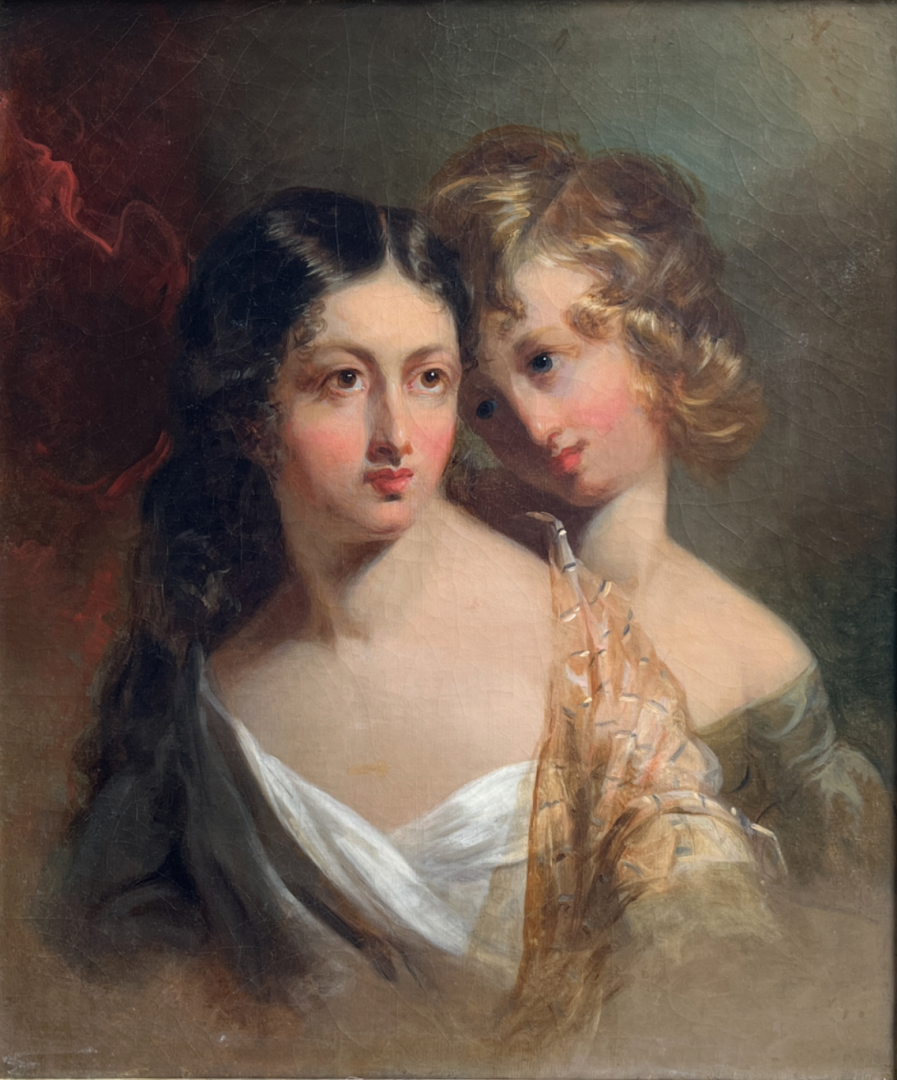
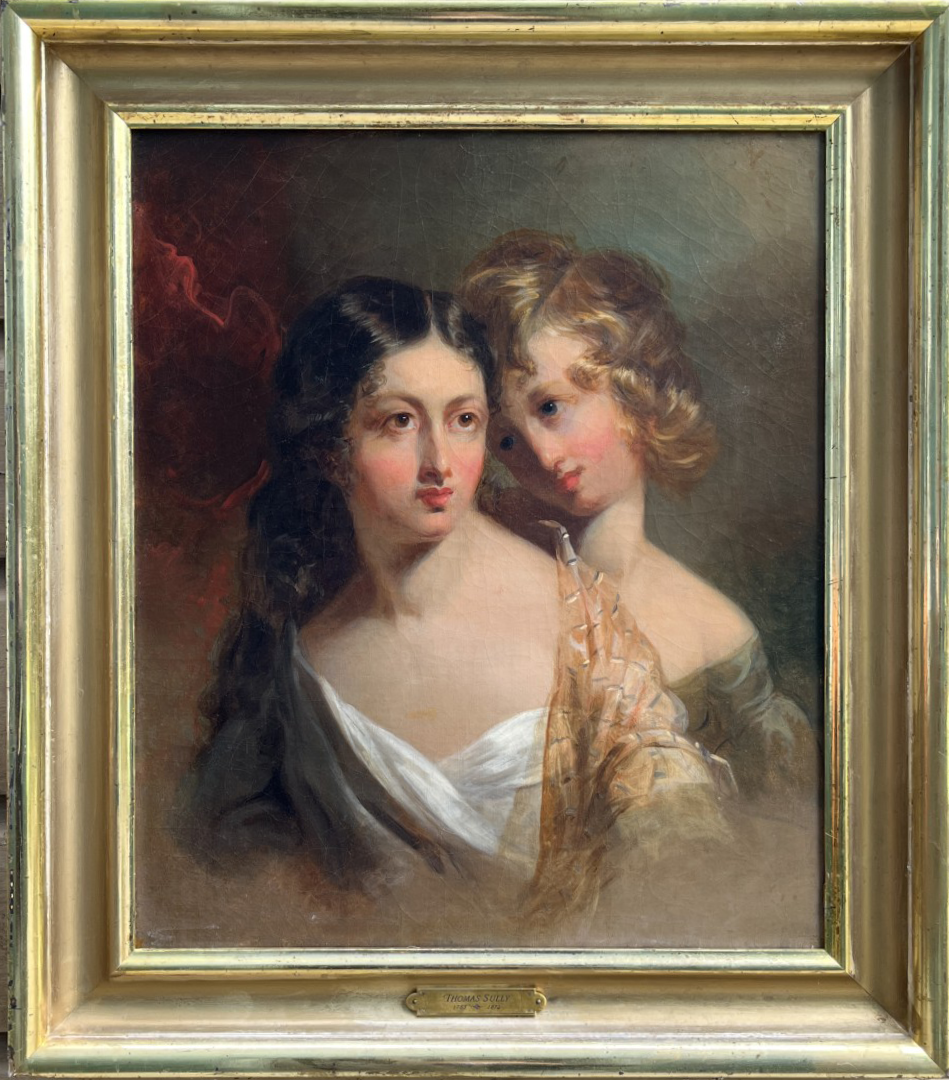

Medium: Oil on canvas
Image Size: 24” x 19”
Frame Size: 30” x 26”
Signature: Philadelphia canvas stamp verso
Price: $12500
Biography/Statement
Thomas Sully, (born June 19, 1783, Horncastle, Lincolnshire, Eng.—died Nov. 5, 1872, Philadelphia), one of the finest U.S. portrait painters of the 19th century.
Sully’s parents moved to the United States in 1792, settling in Charleston, S.C. He was a pupil of Gilbert Stuart in Boston (1807) and of Benjamin West in London (1809) and was influenced by the portrait artist Sir Thomas Lawrence. After 1810 he made Philadelphia his home, although in 1838 he visited London to paint a full-length portrait of the young Queen Victoria for the Society of the Sons of St. George of Philadelphia. His masterpiece in portraiture is “Col. Thomas Handasyd Perkins” (1831–32; Boston Athenaeum); his best known painting is “The Passage of the Delaware” (1819; Museum of Fine Arts, Boston).
Sully was an industrious painter who worked rapidly; he left about 2,000 portraits, a number of miniatures, and more than 500 subject and historical pictures. His paintings are elegant and romantically warm, emphasizing an economy of form and of color, but his later work suffered from the sentimentality of the mid-19th century.
Source: Britannica
Artist Profile Page: Sully, Thomas / Categories: Portrait
Other Available Works by this Artist:
Similar Works
Carlino, Charles
English Portrait
HopperEdward
Greuze,Jean-Baptiste
Larsen-Sarslov, Frederick
Momand, Arthur
Morgan, William Penn
TannerHenry Ossawa
Theise, Mike
Titian
Titian
Carlo Cherubini (1890-1978) European
"Paris, 1930"


Medium: Oil on Canvas
Image Size: 40” x 29”
Frame Size: 50” x 39”
Signature: Signed and dated "Paris, 1930"
Price: SOLD
Biography/Statement
Carlo Cherubini was born in Venice, son of a famous Venetian painter. He took part in 1914 at the International Exhibition of Venice and the decoration of the Lido in Paris by painting many decorative panels around the theme of carnival. In 1930, he received the medal of honor at the Salon of French Artists and the silver medal in 1932. His works belong to several museums in Italy and many private collections.
Artist Profile Page: Cherubini, Carlo / Categories: Figurative, Portrait
Other Available Works by this Artist:
Similar Works
Brackman, Robert
Carlino, Charles
English Portrait
Guy, Seymour Joseph
Harper, William St. John
HopperEdward
Greuze,Jean-Baptiste
Larsen-Sarslov, Frederick
Low, Will Hicok
Momand, Arthur
Morgan, William Penn
Philipp, Robert
Sohn, Karl Rudolf
Spurr, Barbara
Sully, Thomas
TannerHenry Ossawa
Theise, Mike
Titian
Titian
Desire Francois Laugee (1823-1896) European
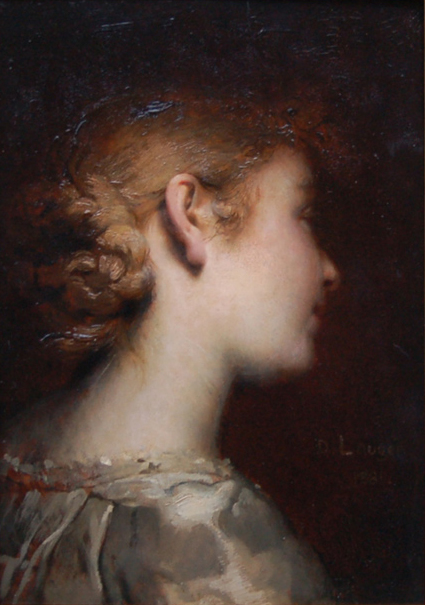
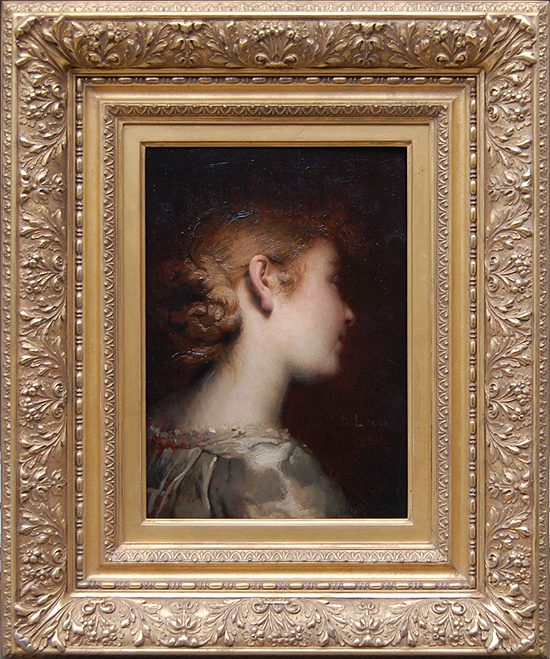
Medium: Oil on Wood Panel
Image Size: 13” x 19”
Signature: Signed and dated 1881 right center
Price: SOLD
Biography/Statement
Désiré-François Laugée was a versatile artist who exhibited at the Paris Salon annually for a fifty-year period (1845-95). Born at Maromme near Rouen, he began his artistic training at Saint-Quentin with Louis-Nicolas Lemasle (1788-1870), a student of Jacques-Louis David (1748-1825). He then studied at the École des Beaux-Arts in Paris under the well-known teacher François Edouard Picot (1786-1868), another student of David. In his paintings of historical and religious subjects Laugée achieves emotional intensity though the powerful rendering of his figures, and the figures in his portraits and genre pictures have the same solidity and presence. Several of Laugée’s Salon entries were purchased by the French government, including Saint Louis Washing the Feet of the Poor (Ministry of State) and The Death of Zurbaran (Ministry of the Interior). Works in museum collections include Peasant Women of Picardy (Museum of Fine Arts, Bordeaux) and A Picardy Woman Spinning Wool (Museum of Fine Arts, Amiens).
Artist Profile Page: Laugee, Desire Francois / Categories: Figurative, Portrait
Other Available Works by this Artist:
Similar Works
Brackman, Robert
Carlino, Charles
English Portrait
Guy, Seymour Joseph
Harper, William St. John
HopperEdward
Greuze,Jean-Baptiste
Larsen-Sarslov, Frederick
Low, Will Hicok
Momand, Arthur
Morgan, William Penn
Philipp, Robert
Sohn, Karl Rudolf
Spurr, Barbara
Sully, Thomas
TannerHenry Ossawa
Theise, Mike
Titian
Titian
Eda Sterchi (1885-1969) American


Medium: Oil on Canvas
Image Size: 30” x 40”
Frame Size: 40” x 50”
Signature: Signed lower left
Price: SOLD
Biography/Statement
Born in Olney, Illinois, Eda Sterchi was a landscape and genre painter who worked in the Midwest, Southwest, Europe, and Tunisia. She was a highly independent woman who was the first among her peers to cut her hair in a bob, the first to get divorced, and the first to smoke cigarettes. Her painting was influenced by European modernism, and many of them had large, abstract fields of color.
She studied at the Art Institute of Chicago and with Lucien Simon in Paris. Her work met with early success, and in 1913 she began exhibiting at the American Artists Club and the International Artists Union in Paris. In the United States, she exhibited at the Chicago Art Institute from 1915 to 1920 and had a one-woman show there in 1929.
In Tunisia, she attended the Institute de Carthage and there she received official recognition from that government for the quality of her art work. She divided her time between that country and Chicago.
In 1910, Sterchi first visited Taos, New Mexico, and from then exhibited paintings of New Mexico, especially at the Art Institute of Chicago. In 1938 and 1939, and from 1940 to 1962, she lived and painted in Phoenix, Arizona during the winters. She was a member of the Institute de Carthage, Chicago Art Club and Chicago Society of Artists
Artist Profile Page: Sterchi, Eda / Categories: Figurative, Modernism, Portrait
Other Available Works by this Artist:
Similar Works
Brackman, Robert
Carlino, Charles
English Portrait
Guy, Seymour Joseph
Harper, William St. John
HopperEdward
Greuze,Jean-Baptiste
Larsen-Sarslov, Frederick
Low, Will Hicok

Milo, George
Momand, Arthur
Morgan, William Penn
Philipp, Robert

Schroeder, Ryan
Sohn, Karl Rudolf
Spurr, Barbara
Sully, Thomas
TannerHenry Ossawa
Theise, Mike
Titian
Titian